Speed Force Spectrum
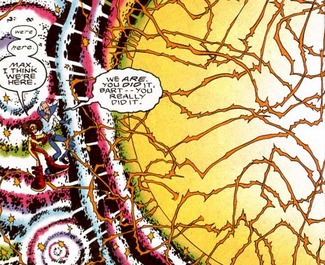
As he explained, the Speed Force is an extra dimensoinal energy and place, a sort of realm of pure energy from which speedsters draw their power from. It explains how the Flash doesn't have problems with mass or perception of time, despite Relativity. It explains how the Flash's costume-or the Flash itself- isn't torn apart by sheer friction. In short, it was intended as a simple MacGuffin to explain the physics problems behind the Flash.
Max Mercury further explained that he had brushed against the Speed Force several times. When he had gotten his powers (From a Native American shaman), he had felt a great urge to push them as far as he could. When he did, he ended up coming into contact against a sort of extra-dimensional wall that rebounded him straight into the future. He did this several more times, until he ended up in the 20th century. He superheroed in the second World War as Quicksilver (His origin- he was originally a Quality Comics character prior to Mark Waid revamping him.)
During a big fight with Kobra, Wally ended up flying head first into the Speed Force. Inside, it was revealed it was a sort of paradise for speedsters. This aspect was re-used several times, most notably in Infinite Crisis #4, January 2006, and 2009's Flash Rebirth miniseries. Wally ended up finding his way back to Earth through his 'lightning rod'- his girlfriend Linda Parks. As sappy as this sounds, it actually has been quite well done in the many times this particular chestnut has been brought out.
The Speed Force was just sort of a catch-all explanation for various Speedster related stuff, though it wasn't really explained much until Geoff's second Flash run. In issue 12 of that particular run, it was revealed that the Speed Force was literally time itself. This actually makes some sense, if you think of space-time as being one thing instead of being separated. I'll give Geoff a pass on this 'crazy' revelation.
STEELsuit MK-1
 This is an odd one, since it's pretty much Steel's armor, and this ain't for talking about the characters.This is a problem when it comes to armored characters with iconic armors based on them- talking about their armor pretty much is them. However, one piece of equipment from this suit is based on something specific- the Entropy Aegis Headguard derives from the ill regarded Our Worlds at War event from 2001.
The event in question revolved around the villain Imperiex, who was a living embodiment of entropy and who wanted to create a new universe by starting a new Big Bang. During said event, Imperiex utilized "probes", which were essentially smaller versions of himself. One such probe was defeated by the forces of Apokalypse, and was crafted into a suit of armor that harnessed the powers of entropy and Apokalyptian science. Superman had been intended to wear the armor against Imperiex, but turned down the armor. Instead, a wounded John Henry Irons instead was bound to it. That all took place in Superman: Man of Steel #117, October 2001.
The armor was used a few more times before the storyline came to a head in Superman Vs. Darkseid: Apokalypse Now, a one shot from March 2003. The armor had steadily corrupted John Henry Irons, allowing Darkseid to take sway over him. He was unbound from him when Superman and various other allies, including Steel's niece Natasha Irons, helped combat Darkseid.
Fate's Faith
 Despite being sold by Raven, this suit is based on the so-called Vestments of Fate. We'll talk about the good Doctor at a later date, but we'll focus on his outfit here in the now, with brief nods for some of the piece names.
There are three parts that make up the Vestments: The Helmet of Fate (Sometimes called the Helmet of Nabu), the Amulet of Anubis and the Cloak of Destiny. We'll cover them in order of importance, from least to most.
The Cloak, I can find nothing on. Seriously, nothing. As far as I can tell, it only exists as a Vestment to cover a continuity gaff, when Kent Nelson didn't have the power of Nabu but continued superheroing as Dr. Fate. It may not even really cover said gap outside of fandom. It's not even part of Fate's Faith, so it's not really even important here. I find that rather amusing.
The Amulet of Anubis was prominently featured in Fate's design, but wasn't actually explained until 1st Issue Special #9, December 1975. In said issue, it was revealed that the God of Death, Anubis, had gifted his priest Khalis with the Amulet. The Amulet granted Khalis with various ill defined abilities, including mind control, as he took control of a legion of slaves to build a big ol' pyramid in honor of Anubis. When Nabu, who was sort of the OG Dr. Fate, came to blows with Khalis, he took the Amulet as a trophy of sorts. Another origin was used in the more recent JSA series, and said that the Lords of Chaos Flaw and Cutter, of Gemworld, had created it.
The Amulet has one cool power in particular. As shown in JSA #3, October 1999, the Amulet has the souls of all previous Dr. Fates dwelling in it in their own personal Heaven. In said issue, the second Star-Spangled Kid (and later Stargirl) is sucked into the Amulet amidst a fight with Mordru. Inside she meets the Golden Age Fate, Kent Nelson, and his wife Inza. They help point her to the latest Dr. Fate, Hector Hall.
By far the most important aspect of the Vestments is the Helmet. It'd be kinda weird if it weren't, considering it is the most prominent aspect, wouldn't it? The Helm first appeared in More Fun Comics #55, May 1940. The origin of the helmet wasn't elaborated on in the Golden Age, though it did go through a drastic shift in October 1941's More Fun Comics #77, where it became a half helmet that only came down to Kent Nelson's nose or so.
The Helmet has never really been explained from what I can tell. In the aforementoined 1st Issue Special, it was revealed that Nabu continued to exist inside the helmet. It's also been said that it can overtake the person wearing the helmet. This was the reason given in All-Star Squadron as to why Kent Nelson melted down part of the helmet- to lessen Nabu's influence on him.
The Helmet is one of the foremost mystic artifacts in the DCU universe. It even had its own miniseries in 2007, picking up from its appearances in Infinite Crisis. It's also had several appearances in other media. It was an important artifact in Smallville, and is currently quite important in Young Justice. In short, it's p important.
There are a few other tidbits in the Fate's Faith set. The shoulders are called the Carcanent of Ur. In Dr. Fate's first appearance, Kent Nelson's father was exploring the Valley of Ur in Mesopotamia when he found Nabu's pyramid.
The Waistguard of Chaos Bound, the Chestplate of Order and the Helmet of Balance all come from the Lords of Chaos and Order that form the backbone of the Dr. Fate mythos. As explained in the 80s Fate series, Nabu is a member of a extra-dimensional race called the Lords of Order that are at perpetual war with the Lords of Chaos. Not much else to say about those without getting overly specific.
 Metallo's Maw
Well, I can't think of a better place to stick a bio about Metallo, nor a better fit for this particular armor, so I guess he'll have to do.
Metallo is one of the higher echelons of Superman rogues, occupying a sort of niche were if there is an a long running adaptation, he will be seen. See: Superman: The Animated Series, Lois and Clark, Superboy and Smallville. He's also been in the majority of Superman games, like the Superman Returns game, or the entirely too many games based on STAS.
So, who is he? He first appeared in Action Comics #259, May 1959. Said issue is much more remembered for the first appearance of Supergirl. In said first appearance, John Corben was introduced as a journalist that led a double life as a murderous thief. Whilst attempting to flee from the scene of a murder he thought perfect, he ended up in the business end of a car wreck.
One of the astounding number of mad scientists running around in the Pre-Modern era of comics found him and transferred Corben's brain into a robot body conceptually not unlike the two Robotmen DC has had, with one twist: It used a piece of uranium as a power source. That's right- in his first appearance, he didn't have a Kryptonite core. Well, he did- Vale told Corben that a local museum had a piece of Kryptonite that could power him forever.
So he attempted to rob it, and guess what happened? It turned out Superman had (wisely) switched the Kryptonite with a piece of painted rock. Corben just sort of keeled over after that. This always made me laugh- in the height of the era of the 'no killing' rule, Superman inadvertently killed one of his villains.
John Corben never came back Pre-Crisis. In Superman #310, April 1977, Corben's brother Roger was willingly transferred into a new Metallo by the generic evil orgnization SKULL in order to get revenge on his (19 years dead, I might add) brother. This Metallo used the Kryptonite core, and a green and orange costume that has became a trademark of Metallo. This is the costume that was brought back in the New Krypton saga, and has also been elsewhere recently, such as in Brave and the Bold and a recent toy.
Roger was erased following the Crisis on Infinite Earths. In Superman vol. 2 #1, January 1987, the new Metallo was introduced. This particular origin has Corben as a two bit thug who gets in a grievous accident. Once again, Vale happens to be nearby. This time, he's a crazy anti-alien guy who somehow managed to get a hole of, and misstranslate, Jor-El's message to his son, so he wanted to make an anti-alien soldier. Vale puts Corben's extant brain into a Terminator inspired robotic skeleton made out of an experimental alloy called Metallo. Clever, no? Metal + alloy = Metallo? Yeah, it wasn't clever a quarter of a century ago, and it ain't clever now.
Anywho, Metallo turned against Vale instantly and killed Vale by snapping his neck. Remember, folks. Never help a robot, because he's just going to snap your neck. Anywho, Metallo came to blows with Superman many times over the next few years. Eventually, during the Underworld Unleashed saga, in Steel v.2 #21, he sold his soul to Neron in exchange for the ability to control and absorb machinary, becoming a giant. It was in this giant form that he most resembles his DCUO form, complete with pistsons on back.
During the end of President Luthor's presidency, Batman came to believe that Corben may have been the thug who shot the Waynes. This was after Joe Chill had been erased from canon but before he had been drawn back in. That never amounted to anything, however, and serves mainly as more trivia.
In the time sense than, Metallo has been rebooted not once, but twice. We won't talk about those, though, as they have no bearing on DCUO. You should check them out regardless, though- Superman: Secret Origin and Grant Morrison's Action Comics are both great.
Frozen Fury
Much like the above, but with Mr. Freeze replacing Metallo. I'd hope that would be obvious, though.
 Mr. Freeze was created by Bob Kane (Actually Shelly Moldoff) and writer David Wood, and first appeared in Batman #121, February 1959 as Mr. Zero. He didn't take the name Mr. Freeze 'till Detective Comics #373, March 1968, though that name originated from the Adam West television series.
Mr. Freeze is one of the foremost cases for character revamps in comics. In his first appearance, he wore a gaudy as hell mauve and green affair. He also had almost no origin- it was just briefly mentoined that he was a cryogenics scientist who spilled some sort of coolant on himself. He appeared a few times in the late Silver and Bronze ages in a better costume, but it wasn't too great either. After that, nada. He wasn't even in Crisis on Infinite Earths. Heck, in Grant Morrison's Animal Man #25, wherein Animal Man goes into Comic Book Limbo, Freeze is there. The poor guy says he's been there so long he's forgotten what a human face looks like. In Robin II #1, he was unceremoniously killed off by the Joker. Oddly, despite this small
His big break came from writer Paul Dini and Hellboy artist Mike Mignola's revamp for Batman: The Animated Series. This added the now most familiar parts: his wife Nora, his name Victor Fries, his now iconic suit that this iconic armor is based on. This version of the character was formally brought into regular canon with 1997's Batman: Mr. Freeze, a one shot designed to coincide with the release of the infamous Batman & Robin. This version added in a new twist: That young Vic had been obsessed with cold as a youth, going as far as freezing animals.
Following that, Mr. Freeze frankly degraded into just another rogue. Unlike his animated counterpart, who had an actual character arc, he had been frozen (no pun intended.) During No Man's Land, he controlled a Gotham power plant for a bit. In Infinite Crisis, he was a member of the Secret Society of Supervillains. Around that time, in Cassandra Cain's Batgirl title, Nora was bizarrely resurrected as a fire themed villain named Lazara. This is best forgotten, however.
Freeze occupies the top niche of Bat Rogues these days, but rarely has any important role beyond that of a goon. He had a semi-important role in the recent night of Owls crossover, but that is beyond the scope of these articles. To keep things related to DCUO, I'll keep the history Pre-New 52, though I have been totally digging the new universe.
Aegis of Azarath
Yeah, there isn't anything here I can't cover when we get to Raven/Trigon/Brother Blood, so let's keep that one for another day.
